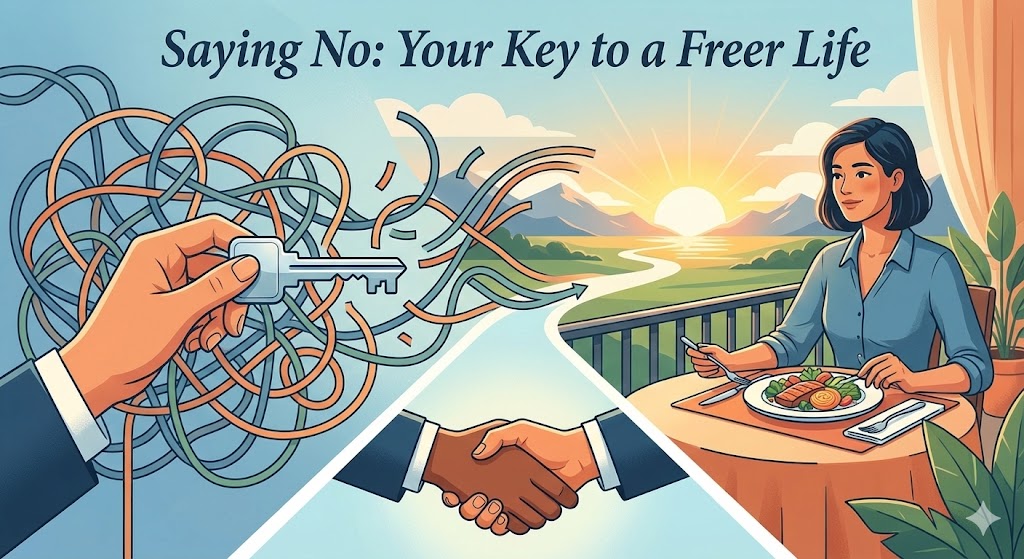
The Philosophy of Refusal: A Declaration to Protect Myself, “I Decided to Live as Myself”
From the moment we are born, we face countless expectations from others. From urgent requests to borrow money to casual blind date favors, requests and refusals are an unavoidable fate in human relationships. However, most people learn ‘how to ask for favors’ but fail to learn the **’art of refusal’**, which requires far more sophistication.
When we fail to refuse properly, our lives devolve into a realm of ’emotional drudgery’ dedicated to processing others’ demands. Now, refusal must be defined not merely as an act of pushing others away, but as the most dignified philosophical decision to reclaim sovereignty over our own lives.
1. The reason for being unable to refuse is not ‘being kind’ but the absence of ‘principles’
Those who find refusal difficult often say they are too kind, or that they cannot bring themselves to speak for fear of hurting the other person. However, to be frank, the real reason for being unable to refuse is not kindness, but the absence of **’one’s own principles (Core Principle)’** that sustain oneself.
“We are not born to satisfy the gaze of others.”
A person with firm standards at the center of their life immediately judges where to expend energy and where not to. On the contrary, an attitude of granting every request is akin to volunteering to live a life consumed by others’ lives without one’s own philosophy. Refusal is not rudeness. The moment you say “no” to an unreasonable demand, you are finally taking the first step towards the life you truly desire.
2. Distinguish ‘predatory demands’ that ignore the process and only covet the outcome
If you desire sustainable human relationships, you must break free from the compulsion to be kind to everyone. Especially, be wary of those who reach out only after seeing the achievements you have painstakingly built.
- Example: A friend tells an expert who receives high lecture fees after years of research and trial-and-error, “You earn a lot of money from one lecture, I’m having a hard time, so share some with me.”
Such requests only see the other person’s ‘outcome’, completely disregarding the painful **’process’** endured to create that outcome. Those who dismiss others’ achievements as luck will not change even after 30 years. Do not try to persuade them. For those who do not respect others’ efforts, a swift termination of the relationship is the wisest answer, rather than polite explanations.
3. The subtle rudeness hidden in ‘conditional apologies’
In conflict situations, the language used by the other person is a mirror reflecting their true feelings towards you. Pay particular attention to the phrase **”I’m sorry if you felt that way.”**
The conditional ‘if you felt’ in this sentence is a subtle device to evade responsibility. It implies an arrogant attitude of, “I’m not at fault, but since you’re sensitive and feel bad, I’ll apologize for now.” A person who repeatedly offers such **’fake apologies’** does not respect you. Do not exhaust yourself by giving opportunities to those who use fake language. Life is too short to spend time with people who do not make you proud.
The Foundation of Refusal: ‘Time Alone’ to Build a Strong Inner Self
The belief that having a wide network leads to success sometimes makes us unhappy. The true power of relationships comes not from ‘quantity’ but from the **’density of connection’**. To refuse well, one needs an inner space where one can exist fully without depending on others.
1. One who knows how to enjoy solitude becomes the master of relationships
People who constantly struggle with relationships feel anxious when they are alone. They attend unwanted gatherings for fear of being left out of the group, and they expend energy on soulless conversations. However, a truly mature adult is someone who possesses an **’inner vessel’** capable of holding their own worries until they are resolved, rather than venting them to others.
- Practical Task: Starting today, choose ‘voluntary solitude’ for just 10 minutes. When you take time to walk alone and converse with yourself, a strong self is formed that is not swayed by others’ opinions or unreasonable demands.
2. Networking is not about expanding, but about ‘precisely narrowing’
The time and money spent trying to know many people are sometimes like a mirage. A wise person refines themselves for **’people who seek them out for their value’**, instead of the exhaustive task of increasing ‘people they know’.
Famous writers minimize external activities and adhere to their own strict ‘principles of meeting’ not out of arrogance. It is to secure time for contemplation and reading by refusing unnecessary connections, thereby enhancing their own value. A network diet can be lonely, but those empty spaces are invariably filled with deeper and more precious connections.
3. Objectify relationships with a ‘point system’
Human relationships are like bank accounts. Mature individuals approach others cautiously when asking for favors, as if using their ‘credit points’. In contrast, those who only want to withdraw indefinitely without any consideration simply view you as a ‘resource’, not a partner.
| Type | Characteristics | Response Strategy |
|---|---|---|
| Mature Relationship | Expresses apology and gratitude, requests only when absolutely necessary | Maintain as a relationship that supports mutual growth |
| Exploitative Relationship | Asserts rights as a given, repeatedly requests minor benefits | Consider points exhausted and refuse firmly |
The Art of Refusal: How to Set Boundaries Gracefully Without Hurting Others
The essence of refusal is not a severance from the other person, but communication that clarifies mutual boundaries. Here are sophisticated techniques to maintain your principles while being considerate of others.
1. Utilize the ‘time-lag strategy’
Do not make the mistake of accepting a request in a panic as soon as it is received. Instead of an immediate response, it is important to take **”time to think.”**
- Secure Leeway: Respond with, “Could I check my schedule and get back to you in three days?”
- Foster Self-Reliance: As time passes, the other person’s urgent emotions will subside, and there’s a high probability they will have found other alternatives in the meantime.
- Manage Expectations: A refusal delivered after sufficient consideration will be much more convincing to the other party.
2. Use ‘internal principles’ and ‘systems’ as a shield
Attribute the reason for refusal not to personal feelings, but to rules or values that you cannot change.
- Identity-Based Refusal: “I have a principle of not engaging in financial transactions between friends. It’s because I want to keep you as a valuable friend.”
- Structural Refusal: “I truly want to help, but due to our team’s current operating policy, this matter is difficult to proceed with.”
- In this way, a refusal based on **’identity’ and ‘principles’** rather than ‘behavior’ makes it difficult for the other party to continue the argument.
3. ‘3-step polite feedback’
A blunt refusal leaves a wound, but step-by-step feedback builds trust.
- 1st Step (Receipt): Confirm the request and convey your intention to review it diligently.
- 2nd Step (Process): Share the current difficulties in the interim, showing that you are making sufficient effort.
- 3rd Step (Final): Deliver the final refusal with regret, and suggest alternatives or future opportunities.
Refusal in the Workplace: The Dignified Coordination of an ‘Effective Worker’
Refusal in the workplace should not be a simple refusal, but **work negotiation**. An attitude of unconditional acceptance leads to overload and ultimately degrades the quality of overall work.
1. Refusal and Coordination Strategies by Career Level
- Junior (Under 3 years): Instead of “No,” ask about **”priority.”** Ask, “I’m currently working on task A, should I pause this and start the new task?” to let your superior decide.
- Middle (3-7 years): Grasp the **”context of the task.”** “If you could explain why this request is more urgent than the project currently underway, I will try to reallocate resources.”
- Senior (Over 8 years): Propose **”strategic alternatives.”** “I think this approach would align better with the company’s goals than the method you suggested.”
2. The Subtle Dignity Shown When ‘Being Refused’
Just as important as knowing how to refuse is the attitude with which you accept refusal.
- Gratitude and Respect: The composure to say “Thank you for considering it” when refused shows your character.
- No Interrogation: Prying into the reasons for refusal is disrespectful to the other person. Acknowledge that the other person has the right to refuse.
3. Quantification of Emotions and Self-Respect
The reason people who cannot refuse suddenly explode is because they have suppressed their emotions. Try to rate your anger or discomfort on a scale of 1 to 10. When the number is around 3 or 4, it is a much more mature response to create a buffer zone in advance by saying, **”I’m not feeling well right now, let’s talk about this later.”**
💡 Concluding Thoughts: Refusal is the Key to a Freer Life
Refusal is not merely a cold act of dismissing someone’s request. It is the most sincere confession that **”I am the owner of my life, and I want to build a healthy and sustainable relationship with you.”**
Instead of using belittling expressions like “I just ate a meal” towards yourself, use language of respect such as “I carefully prepared and ate a meal for myself.” When you value yourself, the world will finally take your “no” seriously. The precious time and energy you secure through refusal will make your future shine even brighter.