This article was written on 10 November 2026.
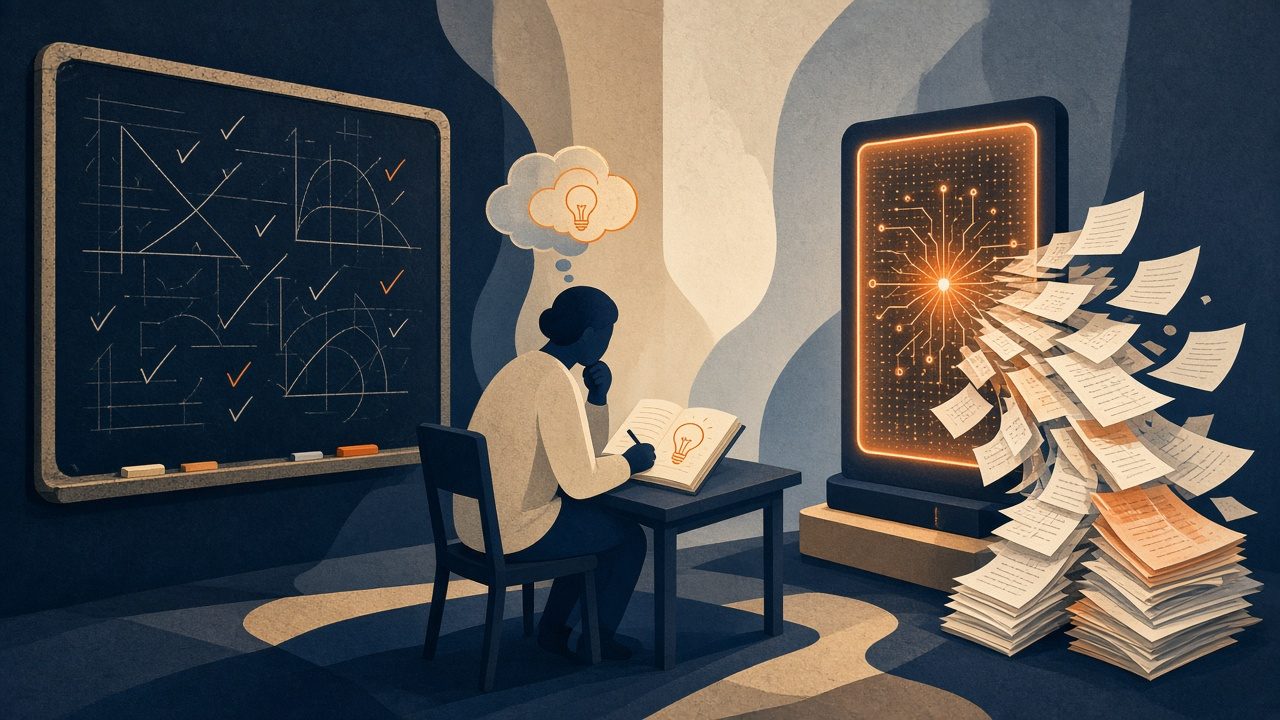
In one line: In a recent lecture, mathematician Terence Tao said that thanks to AI, proofs are now abundant, yet human understanding is shrinking. So, he argues, we need to move beyond Math 1.0, where AI solves problems for us, to Math 2.0, where AI helps us grow our understanding.
Why is AI so strong in mathematics?
Tao gave three reasons why solving problems in pure mathematics suits AI so well.
- It can be verified — whether a proof is right or wrong can be checked objectively.
- It is entirely digital — everything happens inside a computer, with no clinical trials or field data.
- There is plenty of good data — thousands of years of textbooks and papers already exist.
Conversely, he said, if even one of these three is missing, AI is “embarrassingly bad.” It is a jagged technology, with an extreme gap between what it does well and what it does poorly.
From an age of too few proofs to an age of too many
In the past, when a hard problem was solved, people in the field would stop what they were doing to read and discuss it together. Today it is the opposite. Tao says that a dozen or so results he cared about have been proved, but he has no time to read them.
He also pointed out that the impressive results you see on social media are only part of the picture. According to him, behind the roughly 300 solutions that OpenAI announced with great fanfare was a footnote: about 4,000 problems had been attempted, and only around 9% were solved. The 91% that went unsolved simply never make the news.
An experiment where people and machines solved 22 million problems together
The example Tao gave of “experimental mathematics” was the Equational Theories Project, launched in 2024. It settled, without a single gap, whether each of 22,028,942 implications among 4,694 simple algebraic laws was true or false, and reached its goal on 14 April 2025. Every proof and counterexample was checked in Lean, a proof-verification language.※
In the lecture, Tao said, “Any single problem could be solved by a graduate student in 30 minutes, but I didn’t have 22 million graduate students.” He explained that about 50 volunteers got it done by combining “old-fashioned AI” such as automated theorem provers with calculations by hand.
Once data on this scale exists, mathematics, like other sciences, can start drawing a map of “where it is hard and where it is easy.” This is what Tao calls the explosion of experimental mathematics.
※ Source: The Equational Theories Project paper (arXiv 2512.07087)
The real problem: getting the answer and losing the understanding
This is what worries Tao most. In the past, solving a hard problem meant understanding it, reading papers and talking with people. Along the way, understanding accumulated, new problems emerged, and students grew. Now you can feed a problem to AI and get an answer, but sometimes no one is able to explain that answer.
He does not think this stays inside mathematics. If AI is used the same way on real-world problems such as power grids, air traffic control or drug design, it may exploit a model’s weak points and produce answers that “pass the benchmark but are actually wrong.” That is his warning.
So what does Math 2.0 actually propose?
- Not only solving problems with AI, but rewriting proofs that already exist yet are too long and unfriendly so that they are easier to understand
- Building networks of papers and large-scale libraries that keep being updated, instead of working one paper at a time
- Asking AI to find new methods and insights rather than new proofs
- Getting more mathematicians involved in analyzing where real-world models fail
Tao closed his lecture by saying that the biggest bottleneck is not technology but “imagination.”
As someone who teaches languages
I am a language professional, and I see the same tendency clearly in my field. Whether it is your native language or a foreign one, learning a language takes a long time, and it is hard to see at a glance how much you have improved. In that situation, when you use AI writing and translation that show you the expression you need, or speak for you, before you have even thought it through yourself, it is easy to feel as if your own ability had already grown that much. You end up with the illusion that “I already know this much.”
Use the convenience of AI, by all means. But the learning and effort it takes until you can use that knowledge freely on your own have to come along with it.
The speed at which AI hands out correct answers will only keep increasing. That is exactly why the ability to explain “why” in your own words becomes more valuable. Whether in mathematics or a foreign language, the point is to use AI not as a tool that thinks for you, but as a tool that widens your understanding. Tao’s “Math 2.0” is also a question posed to the way all of us study.
Sources: Terence Tao’s lecture video YouTube / The Equational Theories Project, arXiv 2512.07087